skip to main |
skip to sidebar


T
here's something about the era between 1850 to 1914 Europe that attracts and haunts me. My favorite artists and writers are mostly from this era, many of them associated with Symbolism, Pre-Raphaelite and/or Bloomsbury groups.
So it was a delightful surprise to bump into an exhibition called "The Cult of Beauty" at V&A Museum yesterday. I actually went to see Yoji Yamamoto's show that has been exhibited for a while, but the show on aesthetic movement between 1860 - 1900 with Rossetti and Burne-Jones and rest of the clans is more closer to my heart, and I spent good one and half hour going through the exhibition...until I was kicked out at closing time.
I don't know what fascinates me to the movement and the era; it was a time of great change with nostalgic view of the past, and that juxtaposition may be the attraction. It was, after all, a post-industrial era with the emergence of new middle class and influx of new and exotic culture from imperial expansion in the middle east and the newly accessible culture of Japan (the influence of far east was profound for symbolist such as Whistler.) It was also the time of socio-econmic changes, with alternation with the existing and stubborn class system and sexual politics (to some extent,) with suffragettes starting to march down the streets.
The culture that exists for "art for art-sake" and "beauty for beauty-sake" is intoxicating and decadent; everything is created for the sake of beauty, and that included furniture, clothing, book cover, wallpapers, jewels, utensils and even exhibit space (Whistler's exhibit space consisted of tatami floor and grey wall to maximize the effect of his works!)
It was also interesting to compare aesthetic movement from the past, which is filled with decorative and exaggerated symbolism (peacock, sunflower, lilies) to modern aesthetic style of Yoji Yamamoto who apparently started his career with the belief that "white means lack of all colors and black means concentration of all colors" thus using black as his main palette with no frills. In fact, I found Yoji Yamamoto's designs very Japanese, not as interpretation of Japan/Far East experimented by the western aesthetic of the past, but something ingrained in him, especially his use of fabrics. There are elements of kimono in his works, flowing or coarse, and as successful as he is in the western fashion world, I still find his clothes the extension of Japanese tradition. On a side-note, I really liked his unconventional way of breaking pre-existing rules...my favorite was the video of the catwalk with Charlotte Rampling and Viviene Westwood wearing his menswear in his menswear collection.
I really need to go back to the "Cult of Beauty" exhibit before it ends in July, and also try to get more understanding of this movement by visiting Leighton house, which is supposedly a representation of this movement.
Coincidentally, I'm now reading Alan Hollinghurst's "The Folding Star," a novel set in a town in Belgium about the obsession of the protagonist with the beauty of a boy and a symbolist painter modeled after Fernand Khnopff. With the novel like "The Swimming-Pool Library" and "In Line of Beauty," I find Hollinghurst the descendent of aesthetic writers, with modern and gay twists...the reason why I find it coincidental that I am reading his novel while bumping into the "Cult of Beauty" exhibition.
Talking about coincidence...here's another one...I saw Claire Foy, the actress who played Erin in Channel 4's drama, "The Promise" on the way back from the museum. She was riding the Barkley bike, and I noticed her because I was startled by her piercing blue eyes. She really looked as beautiful as she looked on TV, and even with her petite stature, very recognizable with her stunning eyes. Had she lived in the era of Symbolism, I'm sure she would have been the muse of one of those painters.
A day of delightful coincidences with beauty...
 Britain has been enjoying glorious summer-like weekends in the past few weeks, and I was enticed to go out and enjoy the spring.
My first excursion...Canterbury.
I must confess I have never read the "Canterbury Tales" cover to cover (shame on me for being a history major,) partially deterred by difficulty reading the olde English, but what little I've read, I find them full of medieval raw humors (potty and sexual), and quite enjoyable. So I was delighted to find the attraction called "Canterbury Tales" in town, which is basically an abridged walk-through (literally) version of Chaucer's famous tales. The attraction recreates the atmospheres of medieval inns and towns, including filthy smells, with narrated audio-tour of 5 most famous tales (the knight's tale on Greek princess, town folk's tale on infidel wife, tale by wife of Bath, tale of the monk on fox and cock, and the tale of death and 4 brothers) in an old converted church, and it was a good blush-up session of the tales that I probably won't be motivated to read in near future.
The next stop was the Museum of Canterbury, which is built on the re-constructed monk's hospital. The building was absolutely beautiful, especially the beams and view of the Franciscan Walk and gardens, but exhibition was a bit of disappointment. The only take away was that I learned an awful lot about Thomas Beckett.
I went off the popular path to the remains of the Norman castle, and this was a real find. The castle was built in the 1000's and was used as a prison for ages before it was abandoned and now a ruins. May be because of almost non-existent visitors, but the castle had stillness and serenity that I did not find elsewhere in town. There are stairs to go up and it is worth a climb to get an intimate view of the ruins.


St. Augustine was the next stop, another ruins but former glory in grander scale. Even with the audio guide, my poor imagination could not conjure up its magnificance, but the view of Canterbury Cathedral from the mound of St. Augustine was truly beautiful, and I was glad to have visited the place.


Finally, the Cathedral...
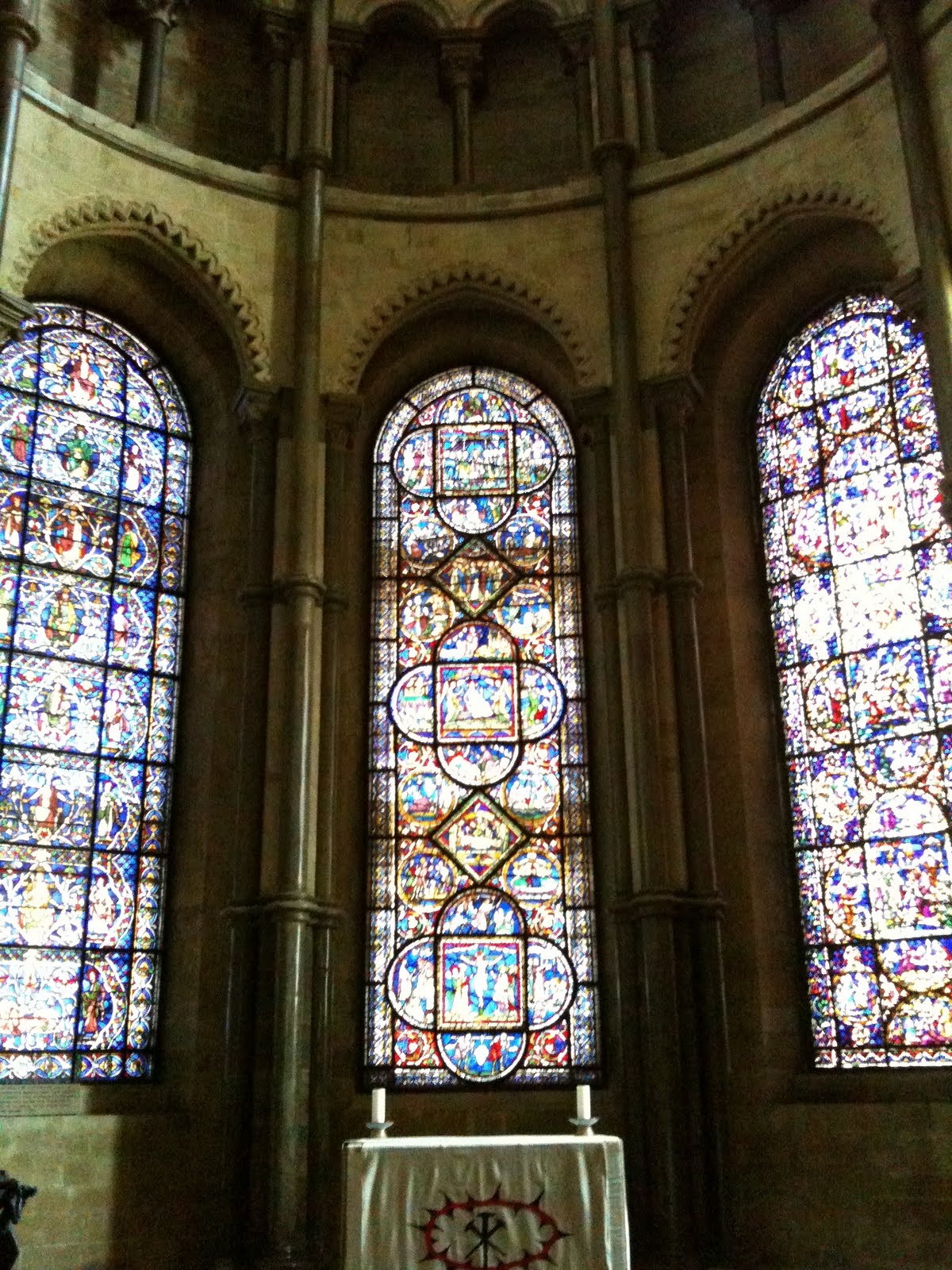
I can say that Canterbury is worth a visit, just to go to the Cathedral. The first thing I noticed was its lightness...unlike many churches and cathedrals, it felt airy and light, filled with warm white grow...even with tall stained glasses and cold stone structure. The illusion may have been created by the height of the structure, or the lack of (or less) buried bodies on the floors (unlike, say Westminster Abbey, where everywhere you go, you feel like you are stepping on someone dead.) Either way, this cathedral felt friendly and welcoming, unlike many that are foreboding and aloof. Even the crypt carried warmth that are dark but comfortable, with no creepy feeling that you get from many of the underground structure without much light, except I felt a chill when I saw a tomb of one the famous priests (forgot what his name was), who was lying peacefully surrounded by curved angels and saints...only they are thoroughly and meticulously defaced with their head knocked off thanks to Oliver Cromwell's armies.
While I was at the Cathedral, there was a choir practice, and this was the highlight of my trip. The voices echoed across the airy and magnificent stone structure, and it was simply otherworldly. The sopranos, the chorus, the voices bouncing off the walls...my soul was pulled up but held back at the same time. Closing my eyes, I felt completely relaxed with floating sensation.
I really don't know what makes Canterbury Cathedral so different from other equally famous cathedrals, abbeys, and churches...perhaps it was built on primitive ground that used to be a place of gathering for long-gone religion that worshiped nature, or perhaps it was a coincidence of architectural magics....but this Cathedral is unlike any other place I've visited, and I now see why the pilgrims flocked for visits in olden days.


Few notes on Canterbury:
- It's only one hour away from London on fast train, so I don't think overnight stay is necessary if traveled from London...unless Ghost Tour is the purpose of your trip.
- Visitors cannot enter the main part of the cathedral while the religious ceremony is going on...but there is a good chance that the Choir will practice after the ceremony, so it will be worthwhile to time the visit toward the end of the scheduled ceremony.
- Franciscan Walk and surrounding gardens are beautiful...when sunny, this will be a good place to have picnics.
- Canterbury is a student town, with University of Kent and other universities and schools packed in and around town.
I've been a big fan of E.M. Forster ever since I watched Merchant-Ivory Productions of his novels during my student days; mesmerizing "Room with A View", powerfully acted and socially complex "Howards End", and my favorite, "Maurice". The film has probably been one of my top favorite of all films, as it resonates for its honesty, pain, and uncertain happy ending. The novel itself is powerful, but the film enhances the emotion, sense of danger, and hopeful naivete of the central character. I also think it is one of the most beautifully filmed British film, from Cambridge landscape to gorgeous Alec to deep green countryside pulled together with subconsciously omnipresent music.
The original book was published posthumously in 1971, and has been revised numerous times since first written in the late 1910's. I just finished reading Wendy Moffat's biography of Forster, "A New Life," which focuses on Forster's struggles with his sexuality and his writings, and begin to understand more about the context of "Maurice" as well as Forster's famous epigraph, "Only connect..."
I always thought "Maurice" more autobiographical than other novels, especially the painful relationship between Maurice and Clive, but thought Alec was a pure fantasy. My assumption turns out to be half right; when it was first written, Alec (a working-class lover with a heart of gold) was Forster's ideal, modeled after Edward Carpenter's lover, George Merrill, but not someone real for Forster. According to Moffat, there is a version of "Marice" in which Alec departs to Argentine, leaving behind heart-broken Maurice in Britain. Some parts of the novel seem to have never changed, especially the first part of the novel focused on Maurice's relationship with Clive (and I was excited to find out that there was a model for Clive...Huge Meredith who was also the model for George in "Room with A View".) Forster eventually revised the version with happy ending, dedicating the novel to "Happier Years" when homosexuality is tolerated without illegality. He also experienced homosexual relationships by then, after finding love in his later years...Mohammed el Adl and Bob Buckingham.
I always picture Forster as keen-eyed observer...someone who observes his surroundings and delves deep into the core of the matters, finding irony, humor and humanity...but not the active participant in life. His understandings of the characters of Cecil, Clive, and Philip (from "Where Angel Fears to Tread") show this trait, as he seems to have real sympathy and close association to these characters (though Clive's platonic homosexuality and conversion to heterosexuality seem to remain a mystery even for Forster.) Most of the photographs of Forster also show him as an introvert and observant, with his hunched back and quiet stillness; eyes showing active mind, but his body remaining placid. In other words, a liberal and free-thinking hermit with quiet and inactive life.
According to Moffat, Forster stopped writing the "publishable novels" after he became active participant in life (ie; started to have active sexual life in his late 30's.) I think she is right in this, as collection of short novels, "Life to Come" published posthumously and written in his 40's and thereafter, seem to be less idealistic when it comes to sexuality. They are more physically present and real, though still secretive and filled with stuffy frustrations. His sexuality is more present in these novels, though even with these traits, I believe he mostly remained an observer than participant throughout his life. This may have resulted from intolerant society that he lived in, or his highly moralistic and structured middle class upbringing. Either way, Forster seems to draw a line between him and others, including his lovers, as he never seems to have had the exclusive lovers who are solely and openly in relationship with him. Both Mohammed and Bob had wives and children (named after him,) and Forster never had the sole exclusive partnership similar to the one enjoyed by Carpenter and Merrill (or Maurice and Alec.)
It is ironic that one of his famous epigraph is "Only connect..." as I believe that is what he wanted most but never fully attained in his life as a supreme observer. Being the master observer made it impossible for him to fully immerse himself in life without care, as he could not help himself from observing himself without harsh criticism.
Yet, how he craved to live and to be connected!
"Maurice" represents this craving, and his idealism filled with secret hopes, thereby exposing his vulnerability. It is so real and painful, almost as if I am forced to look at his naked self and his craving to be "connected", which resonates with me close to my heart.
Forster ended his life with Bob and Bob's wife beside him. He may not have lived in the "Happier Years", in the ideal relationship of Maurice and Alec, but he was probably as close as being "connected" as he could be at the end of his life.
Only connect...
For the past few weeks, I've been hooked on "Shameless", a channel 4 program that has been running in the UK since 2004. I was not aware of this show until I read an article in early January that it was picked by Showtime for the US adaptation and that made me curious about the original UK version.
Thanks to the on-demand channel 4 site, I was able to watch the entire 7 seasons in few weeks, and wondered what made this show a good drama, as opposed to soap opera, albeit dramatic characters and plots. Here are some of my thoughts:
Frank, a great traditional British character
Interesting thing about Frank, an alcoholic father of 6 (by season 7, father of 9) on dole is the fact that his character is very much in the tradition of jesters or fools in British novels and plays. In fact, his constant ranting and unique moral standards are quite similar to Falstaff and Fagin, and perhaps because of the skills of the actor playing Frank, he sounds quite Shakespearean in some of his speeches. He could be quite a philosopher and a keen observer, with surprisingly high intelligence, but his practical aptitudes are non-existent.
Frank also represents the tolerance for failure in Britain, quite an opposite from the way the failures are depicted elsewhere. Having lived in competitive and workaholic countries of USA and Japan, it is refreshing to see his idleness and lack of wills accepted as part of life and fact of the world, not only by Frank, but by the people surrounding him. Frank's character is, by no means new, appearing in Ken Loach, Mike Leigh and other British film makers' films, but by naming the show "Shameless", Frank's unapologetic attitude toward failure constitutes the core of the show, and I find this quite British.
The more we get to know Frank, the more we see his multifaceted character, such as his strong love for his family, but no active role as caregiver, and his sense of entitlement to the government's handouts, but no strong sense of ownership for his possessions (except for his constant needs for alcohol and drugs.) He could be extremely observant to his surroundings, but he cares less about how people see him. This complexity and ambiguity of character makes Frank real, and consequently, set the show apart from the soap opera.
Whether he exists merely as a jester or as a central character in the episodes, he is the omnipresent character, and Shameless is not Shameless without him. After watching full 7 seasons of the shows, I still don't know Frank, and he remains a character with full of surprises.
The moral standards of Chatsworth Estate
Fictional Chatsworth Estate in Manchester is where this show is taking place, and as Frank mentions in his speech, this is not a "garden of Eden", nor anyone's cup of tea. In fact, this is the place where the characters (mostly Frank's children) would do anything to get away from, unless one is happy to live off on permanent government handouts.
What intrigues me from the cultural perspective, is the Estate residence's moral standards. For them, petty crimes such as stealing, fraud, minor violence, drug dealing, abuse, etc., are part of their daily lives and they seem to be quite oblivious. In other words, if you are caught, bad luck, and it really is not your fault. This doesn't mean that they don't have moral standards...they do, and they draw an ambiguous line on what's right and wrong, but they are not based on laws or religious beliefs. This ambiguity may be the reason why the show has been so successful. You just can't guess what the characters will do, because there are no set standards for moral codes, and their decisions are more or less made on their instincts. For many of us, this lawlessness is utter fiction, and as long as they are within the confine of fictional Estate, we can sit back and enjoy the show, because I think deep down, there are desire for us to act upon instincts, rather than on moral codes.
But what if this was reality, and not a complete fiction? In fact, the estate is based on where the creator of the show, Paul Abbot, grew up, and I have seen some viewers' comments that the shows are "too painful to watch because it is too close to home." This means there are world out there, where this estate exists for real.
Other thoughts...
- Season 8 has been a bit of disappointment for me. This is probably because many of the Gallagher children are no longer in the show, and for me, the show was about the Gallagher clan. My all time favorite Gallagher children has been Ian, as I find him a good, but confused and ambiguous soul, but now he is gone, that gentle ambiguity is no longer there and the show seems to become more aggressive and somewhat brutal. Season 8 is more about the Maguire family, and while I like Mickey, this clan tends to act a bit out of my comfort zone, especially without Paddy who had been the anchor of his clan and kept the dynamics of the family intact.
- I've never been to Manchester, but learned few things about the city through this show. At first, I couldn't understand half of their dialogues, but now have ears for their accent. Also, having been an obsessive The Smiths and Morrissey fan during my long-gone student days, I understand better about the cultural context of Morrissey's lyrics, like the word "Strange Way" means prison, and his desperation for not being able to fit into macho and violent surroundings. One of my favorite plots in the show is when Shane and Mickey drug the tourists and take them to see the place where The Smiths used to have gigs, with Shane pretending to be Morrissey with a bunch of flowers on bicycle. Classic!
- I thought slung are universal, but they are not...learning British slung was like learning foreign language. Thanks to online slung dictionary, I get to understand them better now, but not sure if I ever have a chance to use them myself...may be in my sleep.
Until last week, Tate Modern hosted a special Gauguin exhibition, and I was able to catch this very popular and crowded show.
Gauguin has never appealed to me in the past, even if I was quite impressed with his use of colors and bold compositions. After immersing myself in his world for several hours, I confirmed that the exhibition has not changed my dislike for his paintings and it made me wonder why this is the case. The exhibition was well-curated, showing his artworks according to the themes, such as "portraits" and "religion", with plenty of biographical and background information. Gauguin led a sensational life, so his biographical information was crucial for understanding his artistic progression. Through this exhibition, I learned that Gauguin's life and art are one and the same, more so than other artists, as he was an instinctive artist who seem to have been affected by his immediate surroundings.
I'm still not sure why I dislike his paintings. It may have to do with his half-heartened early influence by Pissaro or the sense of flatness in his paintings. On the other hand, I happily discovered that I like his wood-carvings and sculptures, and thought he might have made a better 3 dimensional artist than 2.
As an artist, Gauguin lived an incredible life, but as a person, he would have been someone I did not care to get to know, with his pre-feminist, chauvinist views on women quite typical of his era and incredible drive for artistic mission on the verge of pure selfishness. As his art and life are entwined, perhaps his paintings are acutely mirroring his views, whereas his 3 dimensional works obscure them, and that may be the reason why I prefer his works in non-2 dimensional medium.
Like or dislike, this was an incredible exhibition that helped me understand Gauguin's art and his insatiable drive for life and art.
Finally, 2011 has arrived.
2010 was the year that fundamentally changed many things in my life. I realized that what I believed to be solid and firm are actually fragile and precarious, and the future does not continue in the straight line from the past.
The end of the era should bring forward the new era, but no new era started for me in 2010, as I kept myself in the limbo, wishfully hoping that the new era will show its face and lead me through the chaos. This never happened without my active participation in life, and the year ended with the sense of immobile stagnation.
Luckily, I was in the position to ponder my past and prepare my mental state for the future, but I don't think I used the time wisely. I spent many hours "catching up" on things, or so I claimed to my friends and family, but in reality I was escaping from taking actions because I was in denial that the past has really became the past.
This needs to end now. To be inside the comfort of well-built cocoon is tempting, but this is counter-productive, and I'm still too young to stop living.
According to the Eastern horoscope, luck is cyclical, and there are times of growth and times of stagnation. I was told that 2011 is the year when my new cyclical era of good fortune and growth will start, and so I waited.
There is no more excuse for me to stay status quo, now that 2011 has finally arrived.
My new year's resolution is to accept that the past is really the "past"and move on.